The Cornell Note-Taking Method: A Step-by-Step Guide
Most people take notes the wrong way: they transcribe everything, never look back, and wonder why nothing sticks. The Cornell note-taking method fixes this. It’s a simple page layout — invented at Cornell University in the 1950s — that turns passive note-taking into active learning. Here’s exactly how it works and how to use it.
What is the Cornell note-taking method?
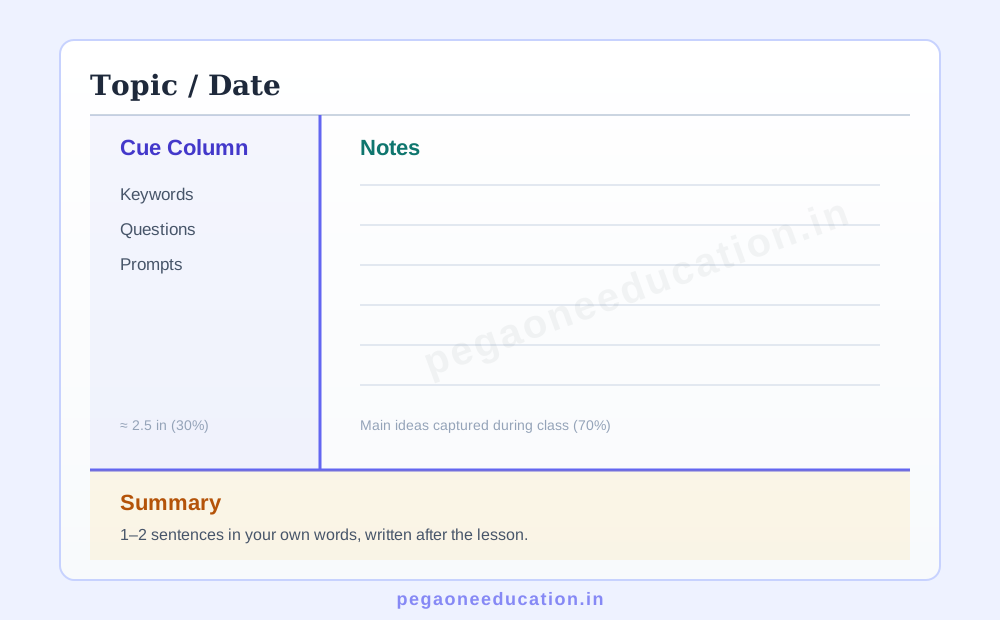
The Cornell method divides each page into three sections:
- Notes area (right, ~70% of the page) — where you write notes during the lesson.
- Cue column (left, ~30%) — where you add keywords and questions after class.
- Summary bar (bottom) — one or two sentences in your own words that capture the page’s main idea.
The genius is in the workflow, not just the layout. By revisiting your notes to create cues and a summary, you review the material a second and third time — and that review is where real learning happens.
How to set up a Cornell page
You can do this on paper or in any note app:
- Draw a vertical line about 2.5 inches (or 30%) from the left edge — this is your cue column.
- Draw a horizontal line about 2 inches from the bottom — this is your summary bar.
- Leave the large top-right block as your notes area.
- Write the topic and date at the top.
That’s the whole template. Reuse it for every page.
How to use it, step by step
The method has four phases, often called the “five Rs”: record, reduce, recite, reflect, review.
1. Record (during class)
In the notes area, capture the main ideas as you listen. Don’t transcribe word for word — write phrases, use abbreviations, and skip lines between topics. The goal is to keep up while still thinking.
2. Reduce (soon after)
Within a day, reread your notes and fill the cue column with keywords and questions that your notes answer. For example, if your notes explain how photosynthesis works, the cue might be “What are the inputs and outputs of photosynthesis?” This step is where most of the learning happens.
3. Recite (active recall)
Cover the notes area and, using only the cues, try to answer each question out loud or on paper. This is active recall in action — retrieving information instead of rereading it. Uncover the notes only to check yourself.
4. Reflect and review
Write your summary at the bottom in your own words. Then revisit the page at spaced intervals — a day later, a week later, before the exam. Each pass takes minutes because the cues and summary do the heavy lifting.
Why the Cornell method works
It works because it bakes in the two most evidence-backed study techniques:
- Active recall — the cue column turns your notes into a self-test instead of something you just reread.
- Spaced repetition — the compact layout makes quick, repeated review effortless.
Ordinary note-taking skips both. You end up with pages you never revisit, and the illusion of competence does the rest. The Cornell method closes that gap by building review into the system itself.
Tips for getting the most out of it
- Write cues as questions, not just keywords. Questions force retrieval; keywords often don’t.
- Keep summaries short. If you can’t summarize a page in two sentences, you haven’t understood it yet — that’s useful feedback.
- Do the reduce step the same day. The longer you wait, the harder it is to reconstruct meaning from rushed notes.
- Pair it with Pomodoro sessions. Use a focused block to record, then a short break, then recite from the cues.
Common mistakes to avoid
- Transcribing everything. The notes area is for ideas, not a full transcript. Capture less, think more.
- Skipping the cue column. This is the step that makes the method work — don’t treat it as optional.
- Never reviewing. A beautiful Cornell page you never reopen is no better than a messy one. Schedule the reviews.
When to use the Cornell method
It shines for lectures, textbook chapters, meetings, and any subject built on concepts and explanations. For pure memorization — vocabulary, formulas — plain flashcards and spaced repetition may be faster. Many students use Cornell for understanding and flashcards for drilling facts, combining the two.
Conclusion
The Cornell note-taking method is one of the simplest upgrades you can make to how you study. Split the page, take notes, turn them into cues and a summary, then test yourself from the cues. You’ll spend less time rereading and remember far more. Try it on your next lecture or chapter — then explore more in our Study Techniques guides.
Frequently Asked Questions
What is the Cornell note-taking method?
The Cornell method splits a page into three parts: a narrow cue column on the left, a wide notes area on the right, and a summary bar at the bottom. You take notes during class, add cues afterward, and write a short summary to lock in understanding.
Why is the Cornell method effective?
It forces you to review and process notes instead of just collecting them. Turning notes into cues and a summary is a form of active recall, which research shows is one of the most powerful ways to learn.
Can I use the Cornell method digitally?
Yes. Any note app that lets you create columns or tables works — split the page into a cue column, a notes area, and a summary row, and follow the same review steps.
Related articles
Active Recall: The Most Effective Study Method
Active recall is the most powerful, research-backed study technique. Learn what it is, why it works, and exactly how to use it.
Study TechniquesHow to Build a Daily Study Routine That Sticks
Build a daily study routine that actually works — using consistent timing, focused sessions, active methods, and habits that beat motivation.
Study TechniquesSpaced Repetition: The Science of Remembering Anything
Learn how spaced repetition works, why it beats cramming, and how to use it to remember anything long-term — with or without an app.